
GREAT HOSPITAL, GREAT PEOPLE, GREAT TIME
Nursing education plays a key role in preparing students for real clinical practice and future work in healthcare. Although Germany and the Czech Republic are both European countries, their nursing education systems differ in several important ways. In this reflection, I compare these two systems and describe what I personally experienced and learned during our two-week internship in Germany.
In the Czech Republic, nursing education usually takes place at secondary medical schools and at higher education institutions such as colleges or universities. Students often start their studies at a young age, and their education includes theoretical lessons and practical training in hospitals. From my point of view, this system provides a solid base of medical knowledge and technical skills. However, the amount of practice can sometimes be limited, and students do not always have enough opportunities to work independently with patients. In many cases, communication skills and professional autonomy depend strongly on the specific ward, supervisor, and the overall approach of the workplace.
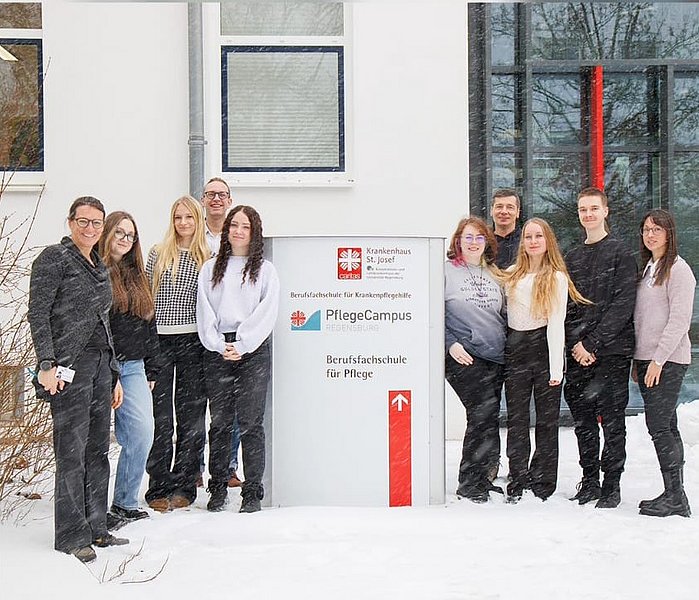
In Germany, the system felt much more connected to everyday hospital reality. Nursing education appeared more practice-oriented and closely linked with daily clinical routines. It is often organized through vocational training programs, for example at Pflegecampus, where theory is directly related to real practice. Students spend a large part of their education in clinical settings and are treated as members of the healthcare team from an early stage. I noticed that they are given more responsibility and are encouraged to communicate actively with patients. What I personally appreciated was the strong emphasis on patient dignity, respectful communication, and holistic care, including mental health.
Our two-week internship in Germany was organized by Pflegecampus. During the first week, we observed how teaching is organized at Pflegecampus and how nursing students are educated. It was interesting for me to see how naturally theory and practice were connected, and how clearly the students understood their role in the healthcare team. We also had an interview with a Czech nurse who has been working in Germany for several years. I found this meeting very inspiring, because it was not only about professional facts, but also about real life experience. It helped me understand the differences between nursing education and nursing work in the Czech Republic and Germany from the perspective of someone who has lived through both systems.
During the first week, we also visited a hospital and a hyperbaric chamber, which introduced us to specialized areas of nursing care. In the hyperbaric chamber, I was surprised by the multi-person version. I had imagined a different type of equipment, so seeing a chamber designed for several people was an eye-opening moment for me. It made me realize how varied healthcare technologies can be, and how different countries may implement the same treatment methods in different ways.
The second week was mainly focused on practice. We worked on hospital wards together with German nursing students, which allowed me to gain real experience and observe different approaches to patient care. I could compare the daily routines, teamwork, and the overall atmosphere in the workplace. We also observed a surgical operation, which was a strong experience for me and helped me better understand how important cooperation between different professionals is. Another important part of the second week was an interesting discussion about delirium and dementia. This reminded me that nursing is not only about physical care and procedures, but also about observing psychological and cognitive changes in patients and responding sensitively to their needs.
One experience that stood out to me personally was the exceptionally practical organization of the intensive care unit. The layout and the system of work seemed very well planned, and it was clear that this arrangement supports both patient safety and efficiency. Seeing this in real life helped me understand how much the organization of space and workflow can influence the quality of care, especially in such a demanding environment.
Overall, this internship was very valuable for all of us, both professionally and personally. I gained new experience and a deeper understanding of the German nursing education system, and I also improved my communication skills in a foreign language, especially in professional situations with patients and healthcare staff. Personally, I took away new skills and experience that I can apply in my own future practice. One of the most important things for me was realizing how much a friendly and respectful approach can influence patients’ comfort and trust. At the same time, I felt warmly welcomed by the staff and students, and I truly felt accepted among the others. This made the entire stay more comfortable, motivating, and meaningful for me.
Finally, I would like to express my sincere gratitude to Barbara Oberhammer, who organized the entire internship voluntarily in her free time. I appreciate her effort, kindness, and support, because her work played an important role in making this experience possible for us.